
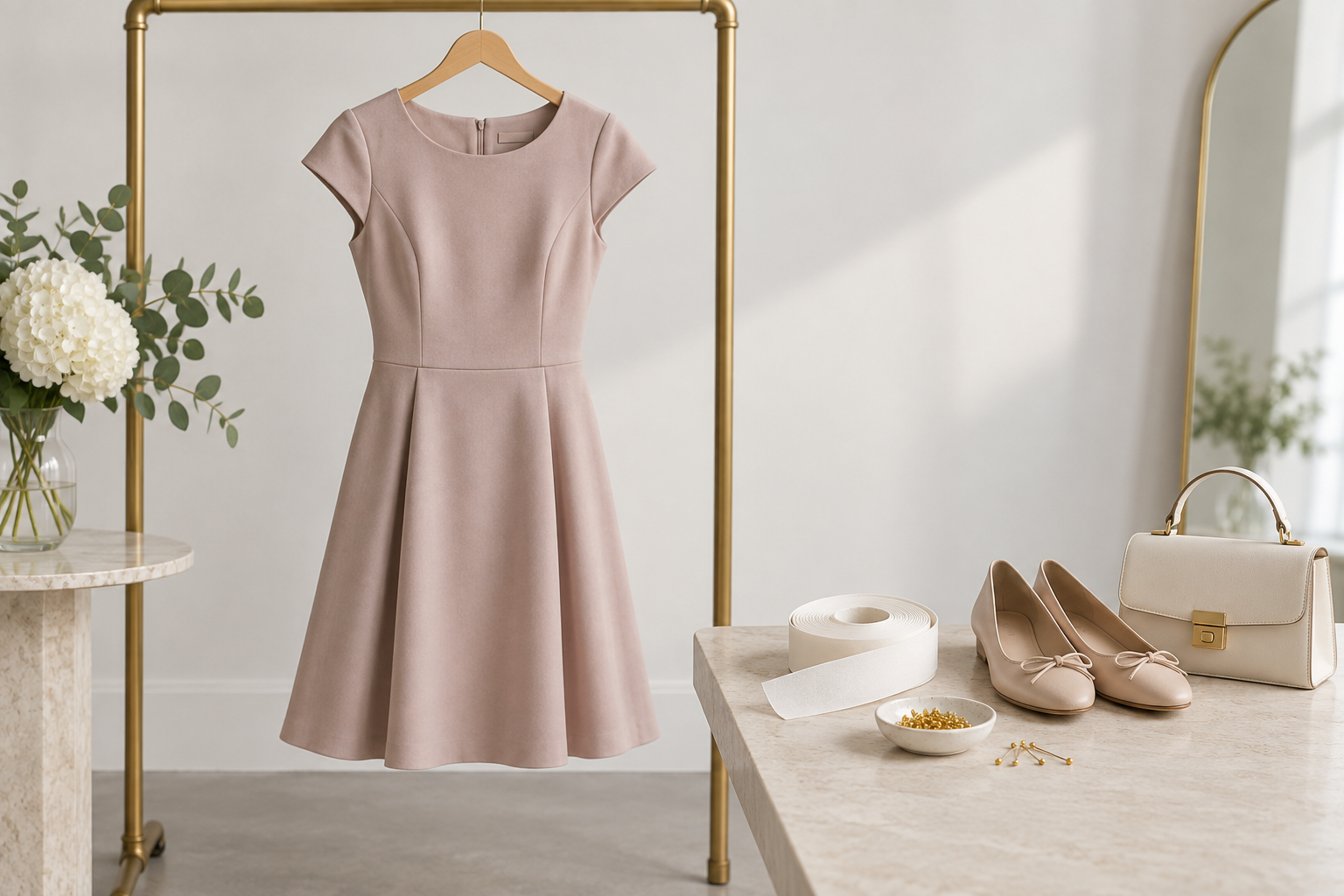
Petite is a proportion system, not only a height label
Petite dresses for women are designed around a shorter overall frame, though the useful difference is usually where the garment puts its details. Shoulder width, armhole depth, bust point, waist placement, sleeve length, and skirt proportion can all change. A regular-size dress may have the right circumference and still place the waist too low or the pockets too far down. Read the garment measurements and construction notes instead of assuming that a smaller regular size will reproduce a petite fit.
Start with the part of your body that most often makes dresses feel wrong. If shoulder seams fall past the shoulder, prioritize a petite cut or a narrow-shoulder measurement. If the waist lands below your natural waist, look for a higher waist seam or a dress with a less rigid bodice. If only the hem is long, a regular dress may still work after a straightforward alteration. Naming the problem prevents you from paying for changes the garment cannot support.
Measure the points a size chart cannot hide
Bust, waist, and hip measurements help with circumference, but finished length and shoulder-to-waist length often determine whether the dress looks balanced. Measure a dress you already like from the shoulder seam to the waist seam, then from the waist to the hem. Compare those numbers with the product details. For a fitted dress, also check armhole depth, sleeve length, and the position of darts or princess seams. Those lines reveal how the pattern was scaled.
The neckline is another proportion cue. A small frame can support a shallow scoop, a narrow V, or a compact square neck, while an oversized collar or very broad lapel may dominate the outfit. This is not a rule against large details; it is a reminder to compare the detail with the rest of the dress. A strong neckline can be the focal point when the shoulder width and hem are controlled.
Choose the hem for your shoes and daily movement
A petite-length hem is not automatically the most flattering hem. Knee, midi, and ankle lengths each create different visual breaks, and the right point depends on your shoes and the dress volume. A midi hem that finishes at the widest part of the calf can feel heavy if the skirt is full, while a narrower skirt may carry it well. Compare the finished length with your own body and the shoes you intend to wear, not only the styling on a tall model.
Movement should be part of the length test. Sit down, climb stairs, and walk at a normal pace. A fitted skirt may need a back slit or enough stretch to avoid limiting your stride. A full skirt may need a lining that moves with the outer fabric instead of catching. If you are shortening a dress, check how the hem shape, border, or print repeat will change before paying for alterations.
Use print, color, and seam lines deliberately
Print scale affects the visual rhythm of a dress. A small print can keep a simple silhouette light, while a larger print can work when the garment has clean uninterrupted panels. Closely placed horizontal bands may create a strong break; vertical seams, a long placket, or a continuous color column can create length. These are styling variables rather than universal rules. Choose the effect you want, then check whether the print placement remains intentional at the bust, waist, and hem.
Seam lines can do more work than decoration. A shaped waist seam, vertical panel, or narrow contrast edge may define the figure without adding bulk. Large pockets, oversized buttons, and heavy trim are worth checking at their actual scale. If the listing does not show a close view, look for garment measurements and customer images. A detail that looks refined in a wide product shot can become the dominant feature on a shorter dress.
Know which alterations are worth the cost
Shortening a simple skirt or adjusting a sleeve can be reasonable when the dress fits the shoulders and torso. Moving a waist seam, reshaping a neckline, changing a lined bodice, or altering a complex pleat is more involved. The fabric, lining, zipper, pockets, and decorative hem all affect the price and result. If several major points are wrong, a petite-specific pattern is often a better starting point than a regular dress that needs reconstruction.
Before ordering, calculate the full decision: garment price, alteration estimate, shipping, and the time available before the event. Ask whether the fabric can tolerate the proposed change and whether the print or trim will remain balanced afterward. A dress that needs one predictable hem adjustment may offer excellent value. A dress that needs a new shoulder, waist, and neckline is not a bargain simply because the listing price is low.
The petite dress checklist
Verify the shoulder, bust, waist, hip, sleeve, and finished length measurements. Note the waist placement, lining, stretch, closure, pocket position, and care method. Try the dress with the undergarments and shoes you will actually use, then sit and walk before removing tags. Examine whether the fabric recovers after movement and whether the details stay aligned. A return window is useful only if you use it before alterations or washing.
The best petite dresses for women do not depend on a single optical trick. They fit the shoulder and torso, place the waist where you expect it, finish at a deliberate point, and let the details support the silhouette. Treat proportion as a set of measurements, then use color and accessories to express the mood. That process produces a dress that looks considered in ordinary life, not only in a product photograph.


